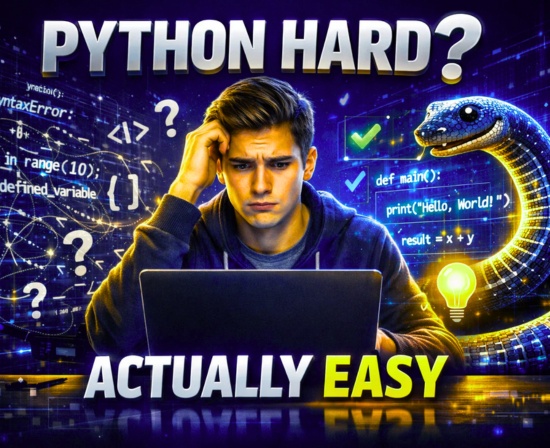
Have you ever looked at a screen full of code and thought ,"There’s no way I can do that without a PhD in Math"? You aren’t alone. Many people in Amritsar want to upgrade their careers but feel held back by the "coding myth."
The truth? Python was designed specifically to be readable and simple. If you can write an email or follow a recipe ,you can learn to code. Let’s break down the most common questions beginners ask before starting their journey.
1. Why Does Everyone Say Python is the Best First Language?
Most programming languages look like gibberish to the human eye. But Python is different. It uses a simplified syntax that looks very close to plain English.
For example, to show a message on the screen in Python ,you just type:
print("Hello Amritsar!")
That’s it ,There are no messy setups or hundreds of lines of "hidden" code just to get started.
How Python Differs from Other Languages
- No Semicolons or Brackets: Languages like C++ ,or Java require you to end every line with a semicolon ; and wrap everything in curly brackets {}. Python uses simple indentation (tabs or spaces) to organize code ,which makes it much easier to read.
- High-Level Nature: Python handles complex computer memory management automatically. This allows a beginner to focus on "what" the program should do ,rather than "how" the computer hardware manages it.
2. Do I Really Need to be a "Math Genius" to Start?
This is the biggest myth of all. Unless you are building complex scientific simulations for NASA, you only need basic logic and arithmetic.
- The Reality: Coding is more about problem-solving than solving calculus equations. It’s about breaking a big problem into small ,logical steps.
- The Tools: Python has "libraries" (pre-written code) that handle the heavy lifting. For instance ,if you want to do complex data analysis, you use a library called Pandas. You don't write the math yourself; you just tell Python which data to analyze.
Real-World Proof: Who Actually Uses Python?
You might be surprised to learn that ,the apps you use every day in Amritsar are powered by Python. Understanding how global giants use it can help you see your own career potential. It isn’t just for small scripts; it’s for massive ,global systems.
Why These Giants Choose Python
These companies don't just use Python because it's easy; they use it because it is scalable and reliable.
- Pinterest, for example ,moved to Python because they needed a language that could handle a massive increase in users without crashing.
- Amazon uses Python-based Machine Learning to analyze your shopping habits ,and suggest "frequently bought together" items.
When you learn Python, you aren't just learning a hobby; you are learning the same tools used by engineers at Facebook, Intel ,and IBM.
4. What Can You Actually Build as a Beginner?
One of the best ways to learn is through "Quick Win" projects. By the end of your first few weeks of consistent study ,you could build:
- A Personal Finance Tracker: A script that logs your daily expenses and saves them to a file.
- A Weather Notifier: A program that "scrapes" a weather website and sends you an email if it's going to rain in Amritsar today.
- A QR Code Generator: A five-line script that creates a custom QR code for your business or social media profile.
- An Automated File Organizer: A tool that automatically moves downloads into folders like "Images," "PDFs," ,and "Videos."
5. Is it "Too Late" or "Too Hard" to Start as a Non-Techie?
Not at all. In fact, Python is now the top choice for professionals in non-IT fields like Digital Marketing, Finance ,and HR.
- Automation: Imagine writing a script that organizes thousands of files or sends 500 personalized emails in seconds.
- Data Science: Python helps you turn messy spreadsheets into beautiful ,interactive charts that help businesses make better decisions.
- AI Ready: Python is the language of the future powering everything from ChatGPT to self-driving cars and voice assistants like Alexa.
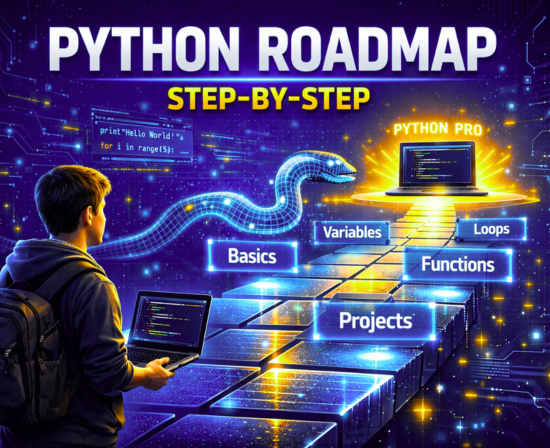
6. A Roadmap for Absolute Beginners (The First 90 Days)
If you are starting today, here is how you should structure your learning:
Month 1: The Basics
- Learn how to install Python and a code editor like VS Code.
- Understand Variables (how Python remembers data).
- Master Data Types (Strings, Integers, Lists ,and Dictionaries).
Month 2: Logic & Control
- Learn If/Else Statements (teaching your computer how to make choices).
- Understand Loops (doing the same task 1,000 times automatically).
- Write your first Functions (reusable blocks of code).
Month 3: Working with Data
- Learn how to read and write files (TXT, CSV ,or Excel).
- Explore APIs (how your code talks to other websites like Google or OpenWeather).
- Start your first "Portfolio Project" to show off what you've learned.
7. Learning in Amritsar: Online vs. Offline
While you can learn online via YouTube or Coursera ,many beginners quit because they get stuck on a single error.
- Online: Great for flexibility and low cost. However ,it requires extreme discipline.
- Mentorship: Having a mentor can change everything. Searching for a local community, such as a Python course in Amritsar with placement ,is often the best way to find peers who keep you accountable. At Webcooks, the focus is on AI and Automation, moving beyond theory to build tools relevant for 2026.
Final Verdict: Should You Start?
The "hardest" part of Python isn't the code. It's taking the first step. With its lack of prerequisites ,and a massive global community of millions, there has never been a better time to start.
Are you ready to write your first line of code today?
Would you like me to create an infographic outline for the "Roadmap" section that you can use for your website's social media?
Written by
Webcooks Technologies
Webcooks Team